How to Trust Yourself Again After Years of Second-Guessing

When your gut and your head are always fighting
There is a kind of tiredness that does not come from doing too much.
It comes from thinking too much.
It comes from constantly doubting yourself.
From replaying conversations.
Rechecking decisions.
Wondering if you made the wrong choice again.
From asking yourself, again and again, “Did I get that wrong?”
And over time, something quieter begins to happen.
You stop trusting yourself.
Not in a loud, obvious way.
But in small, almost invisible ways.
You hesitate before you speak.
You look to others before you decide.
You override what you feel, just to feel safe.
If you have been living like this for a while, it can start to feel like your intuition has disappeared.
Like your inner voice is gone.
But it is not gone. It has just learned that it is not always safe to be heard.
Learning how to trust yourself again is not about becoming more confident overnight. It is about slowly rebuilding a relationship with yourself. One that feels steady, not forced.

How self-trust breaks when you abandon your own needs
Possible angle:
Saying yes when you mean no
Ignoring discomfort
Dismissing your own feelings
Prioritising being accepted over being honest with yourself
Sometimes it looks small. You know you are exhausted, but still say yes to plans. You know a conversation upset you, but convince yourself you are “being dramatic.” Over time, these moments teach you not to trust your own signals.
What self-trust really is and how it quietly breaks over time
Self-trust is often misunderstood.
It is not about always being right. It is not about making perfect decisions.
And it is not the same as confidence.
Self-trust is quieter than that.
It is the feeling that you can rely on yourself.
That even if things go wrong, you will stay with yourself through it.
That your thoughts, your feelings, your instincts are allowed to exist without being immediately questioned.
And for many people, this is the part that gets disrupted.
Not all at once. But slowly.
Self-trust is not confidence, it is something deeper
Confidence is often built on outcomes. You feel confident when things go well.
Self-trust is different.
It stays, even when things do not go well.
It says, “I can handle this.”
“I can figure this out.”
“I can listen to myself, even if I am unsure.”
And when that is missing, everything starts to feel unstable.
How self-trust gets eroded slowly
Most people cannot point to one moment where they lost trust in themselves.
It tends to happen through repetition.
Being told you are wrong when you felt something strongly.
Having your experiences questioned or dismissed.
Learning that it is safer to rely on other people’s opinions than your own.
And so you begin to check.
Then double check.
Then doubt.
Until eventually, your own voice starts to feel unfamiliar.
The moment you stopped listening to yourself
If you pause for a moment, you might be able to feel this.
A time when you knew something but talked yourself out of it.
A moment where your instinct said one thing, but fear said something else.
And fear sounded louder.
This is often where the shift begins.
Not because you made the wrong choice.
But because you learned that your own knowing was not something you could fully rely on.
How self-trust breaks when you stop listening to your own needs
Sometimes, self-trust does not break through one major event.
It breaks quietly.
Through moments where you ignore what you feel because it seems easier.
Safer.
More acceptable.
Saying yes when you want to say no.
Telling yourself something “does not matter” even when it hurt you.
Staying in situations that make you uncomfortable because you do not want to disappoint anyone.
Over time, these moments teach you something subtle.
That your feelings are not important enough to listen to.
And eventually, you stop checking in with yourself altogether.
Sometimes it looks small.
You know you are exhausted, but still force yourself to keep going.
You know a conversation upset you, but convince yourself you are “overreacting.”
You feel uncomfortable with something, but talk yourself out of it to avoid conflict.
And little by little, your own inner signals start feeling less clear.
Not because they disappeared.
But because you stopped responding to them.
Signs you may have lost trust in yourself
Sometimes the loss of self-trust does not look obvious.
It shows up in patterns.
In the way you move through everyday decisions.
You overthink even small decisions
Things that once felt simple now feel heavy.
Choosing what to say what to wear what to do next
Everything becomes something to analyse.
Not because it is complex but because you do not feel certain.
You constantly seek reassurance from others
You might notice yourself asking, “What do you think I should do?”
Not occasionally. But often.
It can feel comforting in the moment.
But it slowly reinforces the idea that your own judgement is not enough.
You feel anxious after making choices
Even after you decide, there is no relief.
Only more questions.
“What if I chose wrong?”
“What if this backfires?”
And so the decision never really feels complete.
You don’t know what you feel or want anymore
This can be one of the most disorienting parts.
When someone asks you what you want, you hesitate.
Not because you do not care.
But because you are no longer used to checking in with yourself.
When you stop checking in with yourself for a long time, it can begin to feel like you have lost touch with who you are completely.
If that feeling feels familiar, this piece on how to find yourself when you feel lost may help you reconnect with yourself more gently.
Why do I second-guess myself all the time
Second-guessing is not a personality flaw.
It is usually a learned response.
When your internal signals have been questioned enough times, your mind tries to protect you by analysing everything.
It is an attempt to avoid being wrong.
To avoid being hurt.
To avoid repeating something painful.
But over time, it creates distance between you and your own intuition.
Why overthinking makes it harder to trust yourself
Overthinking often feels productive.
Like if you think long enough, you will finally feel certain.
But most of the time, overthinking does not create clarity.
It creates distance.
The more you analyse every possibility, the harder it becomes to hear what you actually feel.
And eventually, decision-making stops feeling intuitive.
It starts feeling like something you have to mentally “solve.”
This is why chronic overthinking and low self-trust are often deeply connected.
Because when your mind is constantly searching for certainty, your inner voice becomes harder to hear.
Why trauma, criticism, and past mistakes make you doubt yourself
Self-trust does not exist in isolation. It is shaped in relationships.
In environments.
In the way your thoughts and feelings were received.
Growing up around criticism or unpredictability
If you were in an environment where feedback felt harsh or inconsistent, you may have learned to second-guess yourself early.
Because the “right” response was not always clear.
And so you adapted by becoming more cautious.
And so you adapted by becoming more cautious, more aware, and more self-questioning.
When your feelings were dismissed or corrected
Being told “You are overreacting”
“That is not what happened”
“You are too sensitive”
can slowly teach you that your internal experience is unreliable.
And if your feelings feel unreliable, your decisions often will too.
The weight of past mistakes
Everyone makes mistakes.
But when mistakes are followed by shame, they tend to stay longer.
You may begin to associate decision-making with risk.
With regret.
With the possibility of getting it wrong again.
And so hesitation becomes a form of protection.
How to rebuild confidence after making mistakes
One of the hardest parts of rebuilding self-trust is learning how to stay with yourself after you get something wrong.
Because many people do not just fear mistakes.
They fear the shame that follows them.
The self-blame.
The replaying.
The belief that one wrong decision says something permanent about who they are.
And after enough painful experiences, even small choices can start to feel dangerous.
But rebuilding confidence does not come from never making mistakes again.It comes from learning that mistakes are survivable.
Sometimes, part of rebuilding self-trust also means learning how to forgive yourself after shame, regret, or difficult decisions.
That one difficult decision does not erase your ability to trust yourself.
Sometimes self-trust sounds like:
“I may not handle this perfectly, but I can handle it.”
That is what slowly changes the relationship between fear and decision-making.
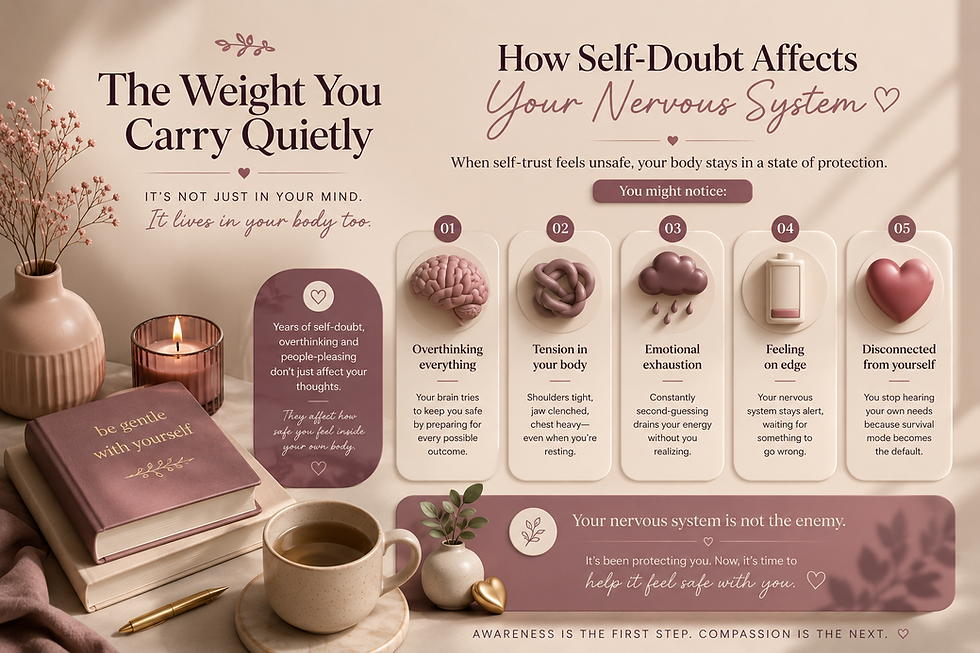
How your nervous system learns to hesitate
At some point, this is no longer just a thinking pattern.
It becomes something your body does.
A pause.
A tightening.
A sense of uncertainty.
And your system is not trying to confuse you.
It is trying to keep you safe.
And sometimes, safety looks like not choosing at all.
Research around the nervous system and trauma responses also shows how chronic stress can affect decision-making, emotional regulation, and feelings of safety within yourself. The American Psychological Association offers helpful resources on how stress and trauma impact emotional wellbeing.
How to trust yourself again starts with smaller, safer decisions
Rebuilding self-trust is not something you force.
It is something you practice.
And it often begins in places that feel almost too small to matter.
Why rebuilding self-trust is not about big life choices
There can be pressure to “fix everything” quickly.
To suddenly make confident, life-changing decisions.
But that usually backfires.
Because your system does not yet feel safe enough for that.
Self-trust grows through repetition.
Not intensity.
Practicing small decisions daily
You might start here.
Choosing what you feel like eating without asking someone else.
Deciding when to rest without justifying it.
Picking something simple and letting it be enough.
These are not insignificant.
They are how you begin to rebuild internal permission.
Letting your decisions be good enough
Part of this process is allowing imperfection.
You might not always choose “right.” But you are choosing.
And that matters more.
How do I start trusting my decisions again
You start by making decisions that feel manageable.
You notice what comes up.
The doubt.
The hesitation.
And instead of trying to eliminate it, you move with it.
Gently.
Over time, your system begins to learn that it is safe to choose.
Learning to tell the difference between intuition and anxiety
This is one of the most common questions.
And also one of the most confusing.
Because intuition and anxiety can sometimes feel similar.
What intuition feels like in the body
Intuition is usually quieter.
It does not rush you. It does not pressure you.
It feels steady. Grounded.
Sometimes it is just a simple knowing without a long explanation.
What anxiety feels like
Anxiety tends to feel louder and more urgent.
It pushes for immediate certainty.
Immediate reassurance.
It often comes with fear, worst-case thinking, or the feeling that something bad will happen if you do not figure everything out right away.
Unlike intuition, anxiety usually creates pressure.
Not clarity.
Why they often get confused
If you have experienced trauma or chronic stress, your system may be more sensitive.
So even intuitive signals can feel intense.
Which makes it harder to tell them apart.
A simple check-in you can try
Instead of asking, “Is this right or wrong?”
You might ask, “Does this feel calm or urgent?”
“Does this expand or tighten something in me?”
You are not looking for perfect clarity. Just a little more awareness.
The journaling practice that slowly rebuilds self-trust
Journaling, when done gently, can become a way back to yourself.
Not as a task.
But as a conversation.
Writing without correcting yourself
One of the most important parts is allowing your thoughts to come through without editing them.
Without making them sound better.
Or more logical.
Just letting them exist.
Questions that reconnect you to your voice
You might begin with simple prompts.
What am I feeling right now even if it does not make sense
What do I need even if I cannot act on it yet
What feels true for me today
These are not questions you have to answer perfectly.
They are invitations.
Tracking moments where you trusted yourself
You can also begin to notice small moments of self-trust.
When you listened to yourself. When you made a choice without overthinking.
Writing these down helps your mind see evidence.
That trust is already there in small ways.
Can journaling help with self-trust
Yes, not because it gives you answers, but because it gives you access.
To your thoughts. To your feelings. To your internal voice.
And over time, that access becomes familiarity.
How therapy can help you reconnect with yourself
Sometimes, rebuilding self-trust is difficult to do alone.
Not because you are incapable.
But because your patterns were shaped in relationship.
And often, they are repaired in relationship too.
Having your internal world reflected back safely
In therapy, your thoughts and feelings are not corrected or dismissed.
They are explored.
And being seen in that way can slowly rebuild trust.
Learning to trust your emotions again
You begin to understand that your emotions are not problems to fix.
They are signals.
And when those signals are allowed they become easier to listen to.
Repairing the relationship you have with yourself
Over time, therapy becomes less about “fixing” something
and more about returning to yourself.
What rebuilding self-trust actually feels like over time
It is not dramatic.
It is subtle.
Less urgency, more clarity
You feel less rushed to figure everything out immediately.
Making decisions without spiralling
The overthinking does not disappear overnight but it softens.
Feeling safer in your own mind
This is often the biggest shift.
Your thoughts feel less like something to fight and more like something you can sit with.
Your self-doubt did not appear out of nowhere
If you have been struggling with self-doubt, it can be easy to assume that something is wrong with you.
That you are indecisive.
Or not strong enough.
But more often, this is about safety.
At some point, trusting yourself did not feel safe.
And so you adapted.
Learning how to trust yourself again is not about becoming someone new.
It is about slowly returning to what was always there.
Rebuilding self-trust is rarely linear.
But every small moment of listening to yourself matters more than you think.
FAQ Section
How long does it take to trust yourself again?
It varies. For some, small shifts happen quickly. For others, it takes longer. What matters is consistency, not speed.
Why do I not trust my own decisions?
Often due to past experiences where your thoughts or feelings were dismissed, criticised, or led to negative outcomes.
Is self-doubt a trauma response?
In many cases, yes. It can develop as a way to stay safe in unpredictable or critical environments.
How can I stop overthinking everything?
Not by forcing your mind to stop, but by slowly building trust so your mind does not feel the need to overanalyse.
Can therapy help me trust myself?
Yes. It can provide a space where your internal experience is validated, helping you rebuild that trust over time.
Counselling to rebuild self-trust
You do not have to figure this out on your own.
If you are trying to learn how to trust yourself again, having someone sit beside you in that process can make it feel a little less overwhelming.
Counselling offers a space where you can begin to hear yourself more clearly, without judgement, without pressure.
And slowly, that voice becomes easier to trust.


Comments