Self-Destructive Behaviour: Signs, Causes and How to Break the Cycle

Why We Hurt Ourselves: Understanding Self-Destructive Behavior
There are moments when something in you already feels heavy and yet, what follows seems to make it heavier
You might:
Saying yes when you want to say no
Staying in draining situations
Numbing out instead of reaching out
And somewhere in the background, a quiet question forms:
“Why would I do something that makes things worse?”
A small pause here
This question often comes with self-judgment as if there must be something wrong with you
But what if we looked at this differently
What if self destructive behavior is not about wanting to hurt yourself but about trying to cope with something that feels difficult to hold
In this space, we are not trying to fix you
We are trying to understand the pattern
Self destructive behavior often doesn’t look obvious. It can show up quietly in everyday choices, especially when you’re already feeling overwhelmed.
What Counts as Self Destructive Behavior?
At its core, Self destructive behavior is a pattern of actions that harm your emotional, mental, or physical well-being, often as a way to cope with overwhelming feelings.
It is not always extreme
When people hear this term, they often think of visible or severe behaviors
But more often, it shows up quietly
Putting off things that matter to you
Overextending yourself until you feel depleted
Staying in relationships that feel misaligned
Ignoring your own limits
These patterns can look functional from the outside which makes them harder to recognize.
It can feel familiar, even comforting
Some behaviors continue not because they work well
but because they feel known.
Familiarity has a certain steadiness to it
even when it comes at a cost.
So you might find yourself returning to:
The same emotional dynamics
The same coping habits
The same internal conversations
Not because you want to struggle but because it feels easier than stepping into something uncertain.
It often happens without full awareness
You may not consciously choose these patterns
They unfold automatically
A response forms a behavior follows and only later do you notice the impact
This is why self destructive patterns can feel confusing
They are not always intentional but they are deeply patterned
The psychology behind self destructive behavior
Instead of asking “Why am I doing this?” it can be more helpful to ask:
“What is this trying to do for me?”
This shift matters
Because many of these behaviors are not random they are responses shaped over time.
Unmet emotional needs
At a quieter level, many patterns are connected to needs that were not fully met.
The need to feel:
Safe
Understood
Valued
Supported
When these needs are not consistently met you learn to adapt
Sometimes that adaptation becomes:
Overworking to feel worthy
Withdrawing to feel protected
Numbing to avoid overwhelm
The behavior may not meet the need fully but it creates some form of relief
Past experiences and learned patterns
If you grew up in environments where:
Emotions were dismissed
Needs were overlooked
Stability felt inconsistent
You may have learned to cope in ways that made sense at the time
Those patterns do not disappear automatically.
They stay with you even when your current environment is different
So what looks like self destruction may actually be something that once helped you manage.
Emotional overwhelm
Some feelings are difficult to stay with
Anxiety
Shame
Loneliness
Uncertainty
When these rise, your system looks for ways to regulate.
And sometimes, the quickest way is to:
Avoid
Distract
Disconnect
Self destructive behavior can become a way of creating distance from what feels too intense.
A protective response, not a harmful intention
A gentle reframe here
These behaviors are often protective
Not in the sense that they solve the problem but in the sense that they reduce discomfort, even briefly.
This does not make them helpful long term but it does make them understandable.
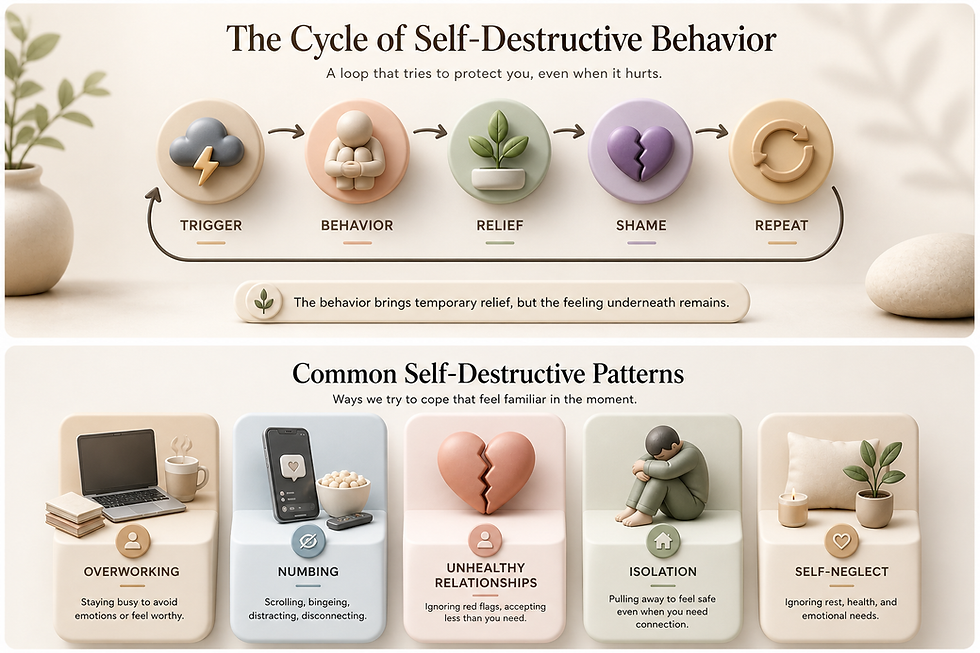
Common self-destructive patterns
These patterns can take different forms and they often overlap.
Overworking and burnout
Staying constantly busy can feel productive.
But sometimes, it becomes a way to:
Avoid difficult emotions
Feel a sense of control
Maintain a sense of worth
Over time, this leads to exhaustion both physically and emotionally.
Numbing behaviors
This might include:
Excessive scrolling
Substance use
Binge-watching or overeating
These behaviors are not random
They create a pause a break from intensity
Even if that break is temporary
Staying in unhealthy relationships
You might notice patterns like:
Ignoring red flags
Accepting less than you need
Feeling unable to leave
These dynamics can feel familiar even when they are not supportive
Self-isolation
Pulling away from others can feel safer at times.
Especially when:
You feel overwhelmed
You don’t know how to explain what you’re feeling
Connection feels uncertain
But over time, isolation can deepen the sense of disconnection.
Self-neglect
This can look subtle
Skipping rest
Ignoring your health
Not tending to emotional needs
It is not always intentional
Sometimes it is simply a result of being disconnected from yourself
How to recognise self destructive behavior in yourself
Recognition is not about labeling yourself It is about gently seeing the pattern
Behavioral signs
Repeating the same patterns despite consequences
Starting something and not following through
Avoiding situations that matter
Emotional signs
Relief in the moment, followed by discomfort
Guilt or frustration afterward
Feeling stuck in cycles
Thought patterns
“I’ll deal with it later”
“This is easier right now”
“It doesn’t matter anyway”
A small pause here
These thoughts are not the problem
They are part of the pattern
And noticing them is already a shift
The cycle of self destructive behavior
Most self destructive patterns follow a similar cycle
Trigger → Behavior → Relief → Shame → Repeat
Trigger
Something creates discomfort
It could be:
Stress
Conflict
Uncertainty
Internal thoughts
Behavior
You respond in a way that creates distance from that discomfort
Temporary relief
There is a brief sense of ease
This part reinforces the pattern
Shame or regret
Afterward, you may feel:
Frustrated
Disappointed
Critical of yourself
Repeat
Because the underlying need or emotion is still present the cycle begins again
Breaking the cycle of self destructive behavior
This is often where people try to push themselves the hardest
To stop immediately
To change everything at once
But lasting change tends to happen differently
More gradually
More quietly
Start with awareness, not control
Instead of forcing change begin by noticing
When the pattern starts
What you are feeling
What feels difficult in that moment
Awareness creates space
And space allows for different responses
Reduce intensity instead of eliminating immediately
Trying to stop a behavior completely can feel overwhelming
You might explore:
Doing it less often
Shortening the duration
Pausing before acting
These are small shifts but they matter
Replace, not remove
Every behavior serves a function
So instead of removing it entirely you can look for alternatives that meet a similar need
For example:
Reaching out instead of isolating
Resting instead of overworking
Pausing instead of reacting immediately
Build emotional tolerance slowly
You don’t have to hold everything at once.
But you might begin by staying with a feeling just a little longer than before
Noticing it
Naming it
Letting it be there briefly
Over time, this builds capacity
Reconnect with your needs
Self destructive behavior often involves disconnection.
So part of the process is asking:
What do I need right now?
What feels manageable?
Not ideal
Not perfect
Just manageable
When to reach out for professional support
Some patterns can feel difficult to shift alone
Especially when they are:
Long-standing
Emotionally intense
Impacting your daily life
Signs you may need support
The cycle feels automatic
You feel overwhelmed trying to change
The patterns affect your relationships or well-being
What therapy can offer
A supportive space can help you:
Understand your patterns more clearly
Work through underlying experiences
Build new ways of responding
This is not about being fixed
It is about being supported as you reconnect with yourself
The Deeper Cause of Self Destructive Behavior
If you step back from the behaviors there is often something quieter underneath
A sense of disconnection
From:
Your emotions
Your needs
Your internal experience
Self destructive behavior is not only about what you do
It is also about how far you feel from yourself in those moments
And healing is not only about stopping behaviors
It is about returning
Slowly
Gently In ways that feel safe enough
What Changes When You Break Self Destructive Patterns
As this connection builds, even gradually you may begin to notice shifts
More pause, less reaction
There is space between feeling and responding
Less intensity in the cycle
The pull toward certain behaviors softens
Increased self-trust
Not all at once
But enough to stay with yourself instead of moving away immediately
You are not trying to harm yourself
It can feel that way sometimes
But most often, these patterns are not about harm
They are about coping
About managing something that feels difficult to hold
A final pause here
What looks like self destruction is often an attempt to take care of yourself with the tools that were available at the time
And new ways can be learned
Not quickly
Not perfectly
But steadily
FAQ
What is self destructive behavior?
Self destructive behavior is a pattern of actions that harm your emotional, mental, or physical well-being, often as a way to cope with overwhelming feelings.
Why do I have self destructive behavior?
Self destructive behavior often develops as a response to emotional pain, unmet needs, or past experiences. It can act as a coping mechanism when feelings become overwhelming or difficult to process.
What are examples of self destructive behavior?
Common examples include procrastination, substance use, staying in unhealthy relationships, overworking, self-isolation, and neglecting personal needs.
How do I stop self destructive behavior?
Stopping self destructive behavior starts with awareness. Recognizing patterns, understanding what triggers them, and making small, gradual changes can help break the cycle over time.
Is self destructive behavior a mental illness?
Self destructive behavior itself is not a mental illness, but it can be linked to underlying mental health conditions such as anxiety, depression, or trauma-related responses.
What causes self destructive habits?
Self destructive habits are often caused by emotional overwhelm, low self-worth, unresolved experiences, or learned coping patterns that once felt protective.
Can self destructive behavior be changed?
Yes, self destructive behavior can change with consistent awareness, support, and small, manageable shifts in how you respond to difficult emotions.
Why do I keep repeating self destructive patterns?
These patterns often repeat because they provide temporary relief from discomfort, even if they create long-term consequences. Over time, they become automatic responses.
When should I seek help for self destructive behavior?
You may consider seeking help if these patterns feel difficult to control, happen frequently, or begin to affect your relationships, work, or daily life.
Trauma-informed counselling
If you find yourself recognizing these patterns and they feel difficult to shift on your own.
You are not alone in this.
You are not trying to harm yourself.
You are trying to cope with what feels hard to hold.
And that can change, one small step at a time.
Self destructive behavior often has deeper layers that take time to understand.

Working with a therapist can help you:
Explore these patterns safely
Build new ways of coping
Reconnect with yourself at your own pace
You don’t have to rush this process
And you don’t have to do it alone


Comments