Therapy for Dismissive Avoidant Attachment: How to Let People In Without Losing Yourself

Updated: Jul 11
“I don’t need anyone.”
It can feel true. Not in a defensive way. Just… factual.
You manage things on your own. You don’t tend to rely on people. And for the most part, life moves forward without needing much emotional support.
But then there are moments that don’t fit as neatly.
A relationship that feels harder to stay in than expected. Someone getting closer, and something in you pulling back. A quiet sense that while independence works, it may also be limiting something you can’t fully name.
This is often where conversations around therapy for dismissive avoidant attachment begin.
Not because something is clearly broken. But because something feels… incomplete.
What Is Dismissive Avoidant Attachment
The experience behind the label
Dismissive avoidant attachment is often described as emotional distance or independence.
But from the inside, it doesn’t usually feel like avoidance. It feels normal.
A preference for handling things alone.
A tendency to keep emotional experiences private.
A sense that needing others is unnecessary, or at times, uncomfortable.
It can look like:
Not reaching out even when something feels difficult
Feeling unsure what to say when conversations become emotional
Valuing space, sometimes more than closeness
There isn’t always a clear resistance to connection. Sometimes, there is simply no strong pull toward it.
And that can make it harder to recognise as a pattern.
Signs of Dismissive Avoidant Attachment
You may not always recognise this pattern immediately because it often feels natural. Some common signs include:
Preferring to handle emotional experiences alone
Feeling overwhelmed during emotionally intense conversations
Pulling away when relationships become closer
Struggling to identify or express feelings
Valuing independence more than emotional closeness
These are not flaws. They are patterns that once helped create stability.
What it can feel like internally
The inner experience is often quieter than people expect.
Not intense anxiety. Not obvious distress. But a kind of distance that shows up in subtle ways.
You might notice:
A tendency to downplay your own emotional needs
Difficulty identifying what you feel in the moment
A sense of detachment, even in relationships that matter
There can also be thoughts like:
“I’m fine on my own”
“I don’t really need much from others”
“This is getting a bit too much” when things become emotionally close
And at times, a quiet contradiction:
Wanting connection… but also feeling more comfortable without it.
This is where confusion can begin. Not in obvious ways, but in the space between what you feel and what you allow yourself to need.
Where This Pattern Often Begins
Early emotional environments
Dismissive avoidant patterns don’t appear suddenly.
They tend to form in environments where:
Emotional needs were not consistently acknowledged
Caregivers were present, but not emotionally available
Vulnerability did not lead to comfort or connection
This does not always look like neglect in an obvious sense.
It can be more subtle.
A child expressing distress and being told to “be strong.” Emotions being met with distraction rather than engagement. A general atmosphere where independence is encouraged early, sometimes prematurely.
Over time, the system adapts.
Not by becoming more expressive. But by becoming more self-reliant.
What the system learns
These early experiences shape something deeper than behaviour.
They shape expectation.
If closeness does not consistently feel safe or responsive, the system begins to organise around that.
It learns:
It may be easier not to depend on others
Emotional needs can be managed internally
Distance can feel more predictable than closeness
This is not a conscious decision.
It is a form of adaptation.
And often, it works.
It allows for stability, independence, and a sense of control. But it can also make emotional connection feel unfamiliar, or even slightly overwhelming, later in life.
How Dismissive Avoidant Attachment Shows Up in Relationships
Emotional shutdown and distancing
In relationships, this pattern tends to appear most clearly when closeness increases.
At the beginning, things may feel easy. Even engaging.
But as emotional intimacy deepens, something can shift.
You might notice:
A need for space after meaningful conversations
Feeling overwhelmed when someone expresses strong emotions
Pulling back without fully understanding why
It’s not always a conscious withdrawal.
Sometimes it feels like: “I just need a bit of distance.”
And that distance can bring relief.
At least temporarily.
Self-sufficiency as protection
Self-sufficiency is often one of the most valued parts of this pattern.
It can feel like strength.
Being able to handle things alone.
Not depending on others.
Maintaining control over your own emotional world.
And in many ways, it is a strength.
But in relationships, it can also become a kind of protection.
A way of:
Avoiding vulnerability
Limiting emotional exposure
Keeping connection within comfortable bounds
Not because connection isn’t wanted.
But because too much of it can feel like losing something important
Space.
Autonomy.
Stability.
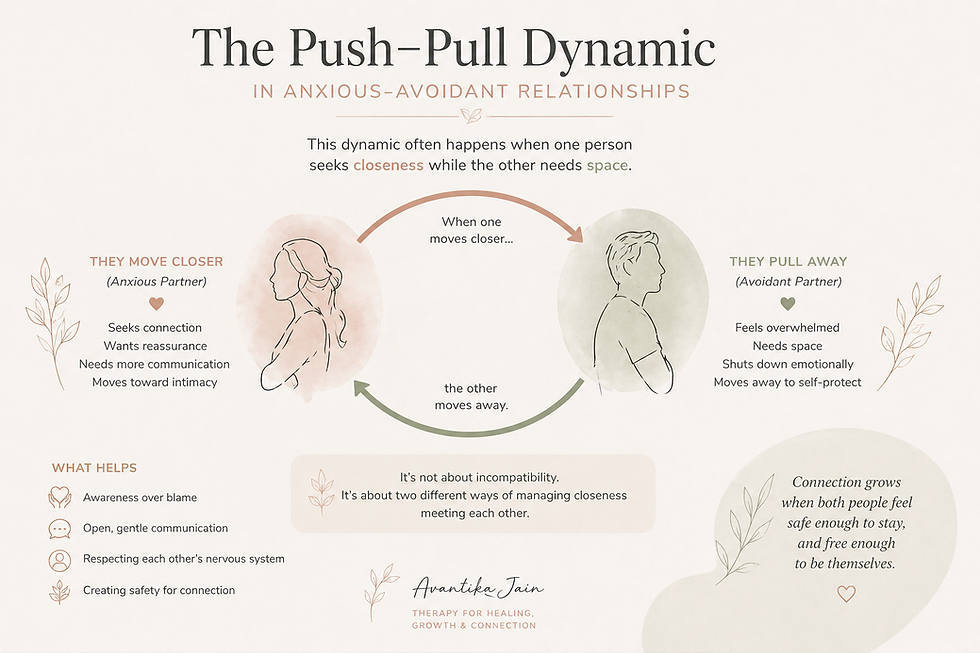
The push–pull dynamic with anxious partners
This pattern often becomes more visible in certain relational dynamics.
Especially with someone who seeks closeness more actively.
They may:
Want more communication
Seek reassurance
Move toward emotional connection
And in response, you may:
Feel the need to step back
Create space
Become less responsive
This can create a cycle.
The more one person moves closer, the more the other feels the need to move away.
And over time, both people can feel:
Misunderstood
Frustrated
Unsure of what’s actually happening
If you want to understand this dynamic more deeply, you can explore the push–pull dynamic in relationships.
Because often, it’s not about incompatibility. It reflects patterns seen in fearful avoidant attachment, where closeness and distance coexist.
Why Many Dismissive Avoidants Do Not Seek Therapy Initially
Therapy can feel unnecessary
For many, therapy does not feel like an obvious step.
There may not be a clear sense that something is wrong.
Life functions.
Responsibilities are managed.
Emotions, while not always fully explored, do not feel overwhelming.
So the thought can be:
“Why would I need therapy?”
And that question makes sense.
Because the pattern is not always disruptive in obvious ways. It is often quietly limiting rather than visibly distressing.
Discomfort with emotional focus
Therapy often involves talking about feelings.
Naming them.
Staying with them.
Exploring them over time.
And if that has not been a familiar way of relating, it can feel:
Uncomfortable
Unnecessary
Even intrusive
There may be a preference to:
Focus on practical matters
Keep things solution-oriented
Move past emotional experiences quickly
So therapy can feel like it asks for something unfamiliar.
Not wrong. Just unfamiliar.
What usually begins to shift this
The move toward therapy is often gradual.
It may not come from a single moment. But from a series of small recognitions.
A relationship that keeps following the same pattern. Someone important expressing a need for more emotional presence. A quiet awareness that independence, while valuable, may also be creating distance.
And sometimes, a simple curiosity:
“What would it be like if this felt easier?”
That question, even if faint, is often enough to begin.
What Therapy for Dismissive Avoidant Attachment Looks Like
It is not about forcing emotional expression
One of the common concerns around therapy is that it will require you to open up too quickly.
To talk about things you are not ready to name. To feel things all at once.
In practice, good therapy does not move that way.
It tends to begin more quietly.
With noticing.
With pacing.
With allowing space to understand your patterns without immediately changing them.
There is no pressure to become more emotional than you are. Or to express things in a way that feels unnatural.
Instead, the work often begins with something simpler:
Becoming aware of when you move away And what that movement is protecting
Building awareness gently
Much of the process is not about doing more. But about noticing more.
Noticing:
When you begin to feel the need for distance
What situations make closeness feel heavier
How your body responds when emotions come closer
This awareness is not analytical.
It is gradual. And often, it develops in small moments.
You might find yourself recognising:
“I usually change the subject here” Or “This is where I tend to pull back”
Nothing needs to be fixed immediately.
But something begins to become clearer.
Expanding capacity for connection
Over time, therapy begins to shift from awareness to capacity.
Not in large, overwhelming ways. But in small extensions.
Staying in a conversation a little longer than usual
Allowing a moment of vulnerability without immediately closing it
Letting someone see a part of your experience, even if briefly
These are not dramatic changes.
But they are meaningful.
Because the goal is not to become a different person. It is to expand what feels possible, without losing what already feels safe.
Types of Therapy That Support Dismissive Avoidant Patterns
Attachment-based therapy
This approach focuses on how early relational experiences shape current patterns.
Not to analyse the past in detail. But to understand how certain ways of relating became familiar.
It helps create a space where:
Closeness does not feel overwhelming
Emotional expression is not expected, but invited
Patterns can be explored without judgment
Over time, this can begin to shift how connection is experienced.
Emotionally Focused Therapy (EFT)
EFT works more directly with emotional responses in relationships.
It helps make sense of:
Why certain moments trigger distance
What is happening underneath withdrawal
How connection and protection interact
Rather than focusing on behaviour alone, it looks at the emotional meaning behind it.
Somatic approaches
Not all patterns are held in thoughts.
Some are held in the body.
A sense of tightening when conversations become emotional
A subtle urge to withdraw physically
A feeling of discomfort that is hard to explain
Somatic approaches work with these responses.
Not by analysing them But by gently increasing tolerance for what is felt.
This can be especially helpful when closeness feels overwhelming without a clear reason.
Concepts around body-based regulation are also supported by research from the National Institute of Mental Health, which explores how emotional responses are processed in the body.
What Changes Through Therapy
Subtle but meaningful shifts
Change in this space is often quiet.
Not a complete transformation
But a gradual softening
You may begin to notice:
Less immediate need to withdraw
More awareness before creating distance
A slightly increased tolerance for emotional closeness
These shifts may feel small at first.
But they tend to build over time.
A different relationship with independence
Independence does not go away.
It remains an important part of who you are.
But it becomes more flexible.
Less like a rule And more like a choice
You can still be self-reliant While also allowing space for connection when it feels right
Moving from avoidance to choice
Perhaps the most important shift is this:
Distance is no longer automatic.
There is a pause.
A moment where you can notice what is happening
And choose how to respond
Sometimes you may still need space.
But it comes from awareness, not reflex.
And that changes the experience of relationships in a meaningful way.
What Partners of Dismissive Avoidants Often Experience
Confusion and mixed signals
From the outside, this pattern can feel difficult to understand.
There may be:
Warmth and closeness at times
Followed by distance that feels sudden
This can leave partners feeling unsure of where they stand.
Not because there is no care But because the expression of it is inconsistent
The impact of inconsistency
Over time, this can create:
Self-doubt
Anxiety
A tendency to overinterpret changes in behaviour
A partner may begin to wonder:
“Did I do something wrong?”
“Why does it feel different now?”
If this feels familiar, you might also relate to when something feels off in a relationship, where confusion becomes part of the experience itself.
What helps in these dynamics
Understanding the pattern can make a difference.
Not as a way of excusing behaviour
But as a way of seeing it more clearly
It can help to recognise:
Distance is often about regulation, not rejection
Withdrawal is usually protective, not personal
This does not remove the difficulty.
But it can reduce the sense of confusion that builds over time.
People Also Ask
Can a dismissive avoidant person change through therapy?
Change is possible.
Not by suddenly becoming more emotional, but by gradually increasing comfort with closeness and awareness of patterns.
Can dismissive avoidant attachment be healed?
Yes, dismissive avoidant attachment can be healed through therapy that focuses on emotional awareness, safety, and gradual connection over time.
How long does therapy for dismissive avoidant attachment take?
There is no fixed timeline.
It depends on:
Readiness
Pace
The depth of patterns
For many, it is a gradual process rather than a quick shift.
Is dismissive avoidant attachment caused by childhood?
It is often shaped by early relational experiences.
But the focus of therapy is less on blame And more on understanding current patterns.
Can dismissive avoidants have successful relationships?
Yes.
Especially when there is awareness, communication, and space for both independence and connection.
What type of therapy is best for avoidant attachment?
Attachment-based therapy, EFT, and somatic approaches are often helpful.
The most important factor, though, is a pace that feels manageable.
A Slower Way of Letting People In
Letting people in rarely happens all at once.
It tends to begin in smaller ways.
Noticing when you pull away
Staying present a little longer
Allowing moments of connection without needing to control them
There is no urgency in this.
Only a gradual shift in what feels possible.
Therapy for Dismissive Avoidant Attachment Is About Expanding, Not Changing Who You Are
Dismissive avoidant attachment is not about not needing people.
It is often about having learned that closeness did not feel reliable enough to depend on.
Therapy for dismissive avoidant attachment does not take away independence.
It allows it to soften.
So that connection does not feel like something that threatens your space But something that can exist alongside it
FAQs
What does dismissive avoidant attachment feel like?
A sense of independence combined with subtle emotional distance, especially in close relationships.
Do dismissive avoidants struggle with intimacy?
Often, yes. Not always consciously, but in how closeness is experienced.
Can therapy help with emotional availability?
Yes, by increasing awareness and comfort with connection over time.
Is avoidant attachment permanent?
No. Patterns can shift with awareness and support.
How do you know if you need therapy for attachment issues?
If relationships feel repetitive, distant, or difficult to sustain, it may be worth exploring.

A Gentle Step Toward Letting People In
If parts of this felt familiar, you may not need to work through it on your own.
Therapy can offer a space where nothing is rushed or expected
Only understood, at a pace that feels manageable
You can explore attachment-focused individual or couples therapy when you feel ready.


Comments