Types of Abusers in Relationships: Subtle Patterns That Are Easy to Miss

Updated: Apr 22
There are moments in relationships that are difficult to hold clearly.
Not because nothing happened, but because what happened does not settle into one simple meaning.
Something may feel off.
A conversation leaves you unsettled.
A reaction feels sharper than expected.
And yet, alongside that, there may still be care.
Connection.
Familiarity.
You might find yourself thinking:
“Maybe I am overthinking this.”
“Maybe this is just how relationships are sometimes.”
This is often where confusion begins.
Understanding the types of abusers in relationships is not about quickly assigning labels.
It is about gently noticing patterns that affect how safe, steady, and clear you feel over time.
If something has felt difficult to name, we can begin there.
What Are the Different Types of Abusers in Relationships
Types of abusers in relationships refer to patterns of behaviour where control, harm, or instability is created through emotional, physical, or psychological means.
These patterns can include:
Controlling behaviour
Emotional invalidation
Intimidation or aggression
Manipulation or gaslighting
Withdrawal or indirect control
Each of these may look different externally. But internally, they often create similar experiences:
Uncertainty
Self doubt
A shift in how safe the relationship feels
Even when the behaviour is subtle, its impact can be real.
Why It Can Be Hard to Recognise Abusive Relationship Traits
Recognising abusive traits in relationships is rarely immediate.
Not because the signs are not there, but because they often appear in ways that are easy to explain, soften, or overlook.
Abuse Does Not Always Look Extreme
When we think about harm, we often imagine something obvious.
Something that clearly crosses a line.
But many abusive relationship traits exist in quieter forms.
A tone that feels dismissive.
A reaction that feels disproportionate.
A pattern that leaves you slightly unsettled, but not entirely sure why.
Because these moments are not always dramatic, they can be easier to dismiss.
Mixed Experiences of Care and Harm
One of the most confusing aspects of harmful patterns is that they rarely exist on their own.
There may also be:
Warmth
Effort
Moments of genuine connection
This combination can make it difficult to hold both experiences at once.
You may find yourself focusing on the good moments to make sense of the difficult ones.
Not because the difficult moments are insignificant, but because the relationship still holds meaning.
The Mind Tries to Create Coherence
When something feels inconsistent, the mind often tries to organise it into a clearer story.
You might begin to:
Rationalise behaviour
Fill in missing explanations
Soften what felt uncomfortable
This is a natural response.
But over time, it can move attention away from what was actually experienced.
The Most Common Types of Abusers in Relationships
Not all patterns look the same.
Some are direct.
Others are subtle.
Some are loud.
Others are difficult to detect at first.
Understanding these patterns is not about placing someone into a fixed category.
It is about recognising behaviours that repeat and shape your experience within the relationship.
The Controlling Abuser
Core Pattern: A need to shape your decisions, environment, or independence
This type of behaviour may not always feel aggressive.
In fact, it can sometimes appear structured, organised, or even protective.
You might notice:
Questions about where you are and who you are with that feel excessive
Opinions that gradually become expectations
Decisions being made on your behalf, even in small matters
At first, these behaviours may feel manageable. Even explainable.
But over time, you may begin to adjust yourself to maintain ease in the relationship.
You might:
Share less to avoid questions
Change plans to prevent conflict
Seek approval before making decisions
The shift is often gradual.
Not forced in one moment, but shaped over many.
The Emotionally Abusive Partner
Core Pattern: Undermining emotional stability and self perception
This pattern often does not involve visible conflict.
Instead, it appears in everyday interactions.
This may show up as:
Your feelings being dismissed or minimised
Subtle criticism that feels difficult to respond to
Conversations that leave you feeling misunderstood
There may not be clear arguments.
But there is a lingering sense of not being fully seen or heard.
Over time, this can lead to:
Questioning your emotional responses
Holding back from expressing yourself
Feeling less certain about your own perspective
The impact is often quiet.
But it accumulates.
The Explosive or Physically Aggressive Abuser
Core Pattern: Intense emotional reactions that escalate quickly
This pattern is often easier to recognise but not always easier to process.
This may show up as:
Sudden shifts in mood
Reactions that feel disproportionate to the situation
Anger that escalates before it can be addressed
In some cases, this may include:
Physical intimidation
Aggressive movement
Direct physical harm
What often follows is equally important.
There may be:
Apology
Regret
Reassurance
And this can create a cycle that feels both intense and confusing.
You might find yourself:
Anticipating reactions
Adjusting your behaviour to prevent escalation
Feeling relief during calmer periods
You may also want to explore how this pattern shows up in more detail in Physical Abuse in Relationships.
The Manipulative or Gaslighting Abuser
Core Pattern: Shifting reality in subtle or overt ways
This type of behaviour often creates confusion rather than direct conflict.
This may show up as:
Conversations being remembered differently
Your experiences being questioned or dismissed
Situations being reframed in a way that shifts responsibility
At first, this may feel like a misunderstanding.
But over time, it can begin to affect your sense of clarity.
You might find yourself asking:
“Did that actually happen the way I remember it?”
“Am I interpreting this incorrectly?”
This pattern does not always feel aggressive.
But it can gradually destabilise your trust in your own perception.
The Victim-Playing Abuser
Core Pattern: Shifting responsibility by positioning themselves as the one being harmed
You may notice:
Situations being reframed so they appear hurt, even when you raised a concern
Guilt being used to redirect conversations
Difficulty holding them accountable without it turning into their distress
You might begin to feel:
Responsible for their emotional state
Hesitant to express concerns
Pulled into comforting them instead of addressing what happened
This pattern can make it difficult to stay with your own experience.
The Passive Aggressive or Covert Abuser
Core Pattern: Indirect expression of control, resentment, or anger
This pattern can be particularly difficult to name.
Because nothing appears overtly confrontational.
You may notice:
Silence where communication is needed
Withdrawal instead of direct expression
Subtle behaviours that create guilt or uncertainty
For example:
Affection being withheld without explanation
Responses that feel distant or delayed
Indirect comments that are difficult to address directly
You may begin to feel:
Unsure of what is wrong
Responsible for restoring connection
Cautious in how you approach conversations
The impact here is often not in what is said, but in what is left unspoken.
Can Someone Show Multiple Types of Abusive Traits
It is rare for behaviour to fit into one clear category.
Most people are not consistent in how they respond, especially in emotionally charged situations.
And in relationships where harm is present, patterns can overlap.
Patterns Can Exist Together
Someone who is controlling may also become emotionally dismissive.
Someone who avoids direct conflict may still use manipulation in subtle ways.
These behaviours are not separate in experience.
They can appear in different moments, but they often create a similar internal impact:
Uncertainty
Emotional fatigue
A sense of instability
Behaviour Can Shift Over Time
At times, a relationship may feel calm.
At other times, something changes.
Reactions become sharper. Communication becomes harder.
What once felt manageable may begin to feel more difficult to hold.
This shift does not always happen suddenly.
It can unfold gradually, making it harder to recognise as a pattern.
Early Abusive Relationship Traits to Notice (Before Patterns Deepen)
Not all patterns begin with intensity.
Some begin in ways that feel almost familiar.
Overcontrol That Feels Like Care
You may notice:
Frequent check-ins that feel difficult to decline
Opinions that gradually become expectations
Concern that feels more like monitoring
At first, this may feel like attentiveness.
Over time, it may begin to feel limiting.
Jealousy Framed as Concern
You might hear:
“I just worry about you.”
“I don’t like how they treat you.”
These statements can feel protective.
But when they lead to restriction or discomfort, it is worth noticing the shift.
Subtle Disrespect or Dismissal
Moments where:
Your feelings are brushed aside
Your perspective is minimised
Your reactions are labelled as “too much”
Individually, these may seem small.
But over time, they can shape how safe it feels to express yourself.
Emotional Inconsistency
You may notice changes in tone or behaviour that are difficult to predict.
Warmth followed by distance. Connection followed by withdrawal.
This inconsistency can create confusion.
Not because you are unclear, but because the pattern itself is.
Pressure to Move Quickly
The relationship may feel intense early on.
You might feel:
Encouraged to commit quickly
Pulled into emotional closeness before you feel ready
Less space to move at your own pace
Intensity can feel meaningful.
But it can also make it harder to notice what is unfolding underneath.
You can explore these early patterns more deeply in signs of an abusive relationship, where these shifts are explained in a more detailed, reflective way.
What These Patterns Often Create Internally
The external behaviour is only part of the experience.
What stays is often internal.
Increased Self Doubt
You may begin to question your own responses.
Wondering if you are:
Overreacting
Misunderstanding
Expecting too much
This questioning can feel subtle at first.
But it can grow over time.
Emotional Fatigue
Trying to maintain balance in an unpredictable environment can be exhausting.
You may find yourself:
Thinking through conversations repeatedly
Preparing for possible reactions
Holding back to avoid conflict
This effort often goes unnoticed, even by yourself.
Loss of Stability
The relationship may begin to feel less steady.
Not always unsafe, but not fully secure either.
You may notice:
Difficulty relaxing
A sense of waiting for something to shift
Unease that is hard to explain
Why Understanding Types of Abusers in Relationships Matters
Understanding does not require immediate action.
It creates space for clarity.
It Brings Language to Experience
Sometimes, the most difficult part is not the experience itself but not having words for it.
When something is named, it can feel more real and less confusing.
It Supports Clarity Without Pressure
You do not have to decide anything right away. Understanding can exist without immediate change.
It can simply allow you to see more clearly.
It Helps You Recognise Patterns Over Time
Whether within one relationship or across different ones, patterns can become easier to notice.
Not all at once.
But gradually.
How to Respond if You Recognise Abusive Traits in a Relationship
There is no single way to respond.
And not every step needs to happen immediately.
Start With Awareness
You might begin by noticing:
What feels consistent
What feels uncomfortable
What stays with you after interactions
Awareness does not need to be forceful.
It can be quiet.
Create Small Emotional Space
If possible, you might allow yourself a little distance internally.
Not to withdraw completely, but to observe more clearly.
This could look like:
Pausing before responding
Not explaining yourself immediately
Giving yourself time to process
Reach for Safe Support
You do not have to hold everything on your own.
If it feels possible, you might consider speaking with someone you trust.
Or exploring confidential support through the National Domestic Violence Hotline or AWARE Singapore, depending on what feels most accessible to you.
Support does not need to lead to immediate decisions.
It can simply create space to think and feel more clearly.
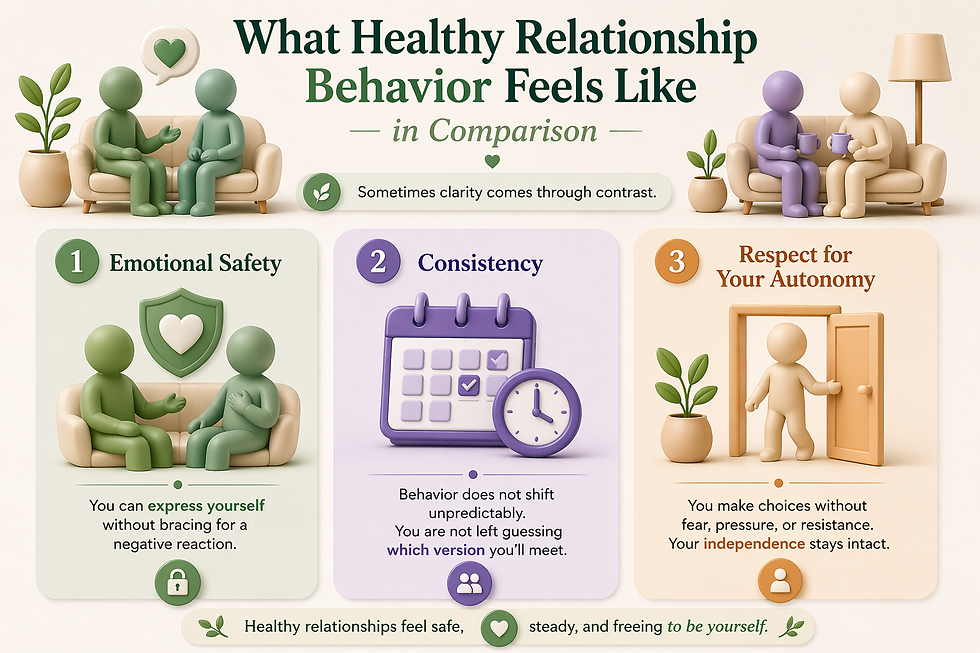
What Healthy Relationship Behaviour Feels Like in Comparison
Sometimes clarity comes through contrast.
Emotional Safety
You feel able to express yourself without preparing for a negative reaction.
Consistency
Behaviour does not shift unpredictably.
You are not left guessing what version of the person you will meet.
Respect for Your Autonomy
You are able to make choices without fear, pressure, or resistance.
Your independence remains intact.
What You Might Take With You From This
Not every pattern becomes clear immediately.
Some take time to recognise.
Some are only understood when you step back and notice how you have been feeling over time.
Understanding the types of abusers in relationships is not about creating rigid categories.
It is about noticing what shapes your experience.
If something creates confusion, self doubt, or a quiet sense of unease, that experience matters.
You do not have to name everything today. You might simply stay with what felt familiar.
And allow that awareness to take its own pace.
FAQ Section
What are the types of abusers in relationships?
Types of abusers include controlling, emotional, physical, manipulative, passive aggressive, and victim playing patterns that create harm or instability.
What are common abusive traits in relationships?
Common traits include control, criticism, manipulation, gaslighting, emotional inconsistency, and intimidation.
Can someone show multiple abusive traits?
Yes. Many individuals show a combination of behaviours rather than fitting into one specific type.
What are early abusive relationship traits?
Early traits include overcontrol, jealousy framed as care, subtle disrespect, emotional inconsistency, and pressure to move quickly.
How do abusive relationships affect you emotionally?
They can lead to self doubt, confusion, emotional fatigue, and a reduced sense of safety or stability.
A Closing Reflection
If something here felt familiar, it does not mean you have to label your relationship immediately.
It may simply be a place to begin noticing.
Clarity often begins quietly.
And that is enough for now.


Comments